US Vote Blog

Recent Content

Image
National voter registration day logo
Happy National Voter Registration Day from everyone at U.S. Vote Foundation! If you are not yet registered to vote, do it now. If you need an absentee ballot, request it now! Remind your friends, family members, or co-workers who to register to vote – show them how – direct them to https://www.usvotefoundation.org.

There are so many speedy 21st century methods to get the word out to your network of contacts. Email your friends and family and let them know it is National Voter Registration Day.
Image
Joy Ann Reid Headshot
By now, you’ve all heard of the ALS Ice Bucket Challenge. People from all over the world are filming themselves as they pour a bucket of ice water over their heads in order to raise awareness and money for The ALS Association, which is fighting amyotrophic lateral sclerosis (ALS), commonly known as Lou Gehrig’s Disease. Upon completing the challenge, the drenched participant looks into the camera and tags additional people to complete the Ice Bucket Challenge. According to the challenge, one may either accept the ice bucket or donate to The ALS Association. Fortunately for The ALS Association, it appears that many participants are doing both, which is growing the profile of this fine organization and helping us get closer to striking out ALS.
Image
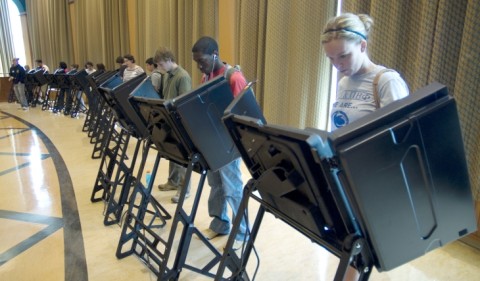
Line of students voting
Recently, U.S. Vote Foundation highlighted the uphill battle being fought by college students who have discovered that their university-issued identification cards and out-of-state driver’s licenses are not accepted at the polls in certain states. Congress has taken notice of these increasing claims of discrimination due to voter ID laws. Voter ID Bill HR 5144 was recently referred to the Committee on House Administration.

The Equal Access to Support Youth (EASY) Voting Act, would “amend the Help America Vote Act [HAVA] of 2002 to require States which require individuals to present a photo identification as a condition of voting in elections for Federal office to accept a photo identification presented by a student which is issued by the school the student attends.” Simply put, the bill would require state and local election officials to accept student photo ID as a current and valid photo ID in federal elections.
Image
Two men speaking with hands to mouth
According to some metrics, the 113th Congress has legislated with less frequency than any other and focused more on battling over contentious partisan issues. However, on July 16, there was a breakthrough. In the U.S. House of Representatives, Voter Registration Bill HRES 672 was referred to the House Committee on Rules and Administration. This resolution provides a push to H.R. 12, which was introduced in 2013 “to modernize voter registration, promote access to voting for individuals with disabilities, protect the ability of individuals to exercise the right to vote in elections for Federal office, and for other purposes.”
Image
Young man filling out registration form
The 2014 New York Times article, “Students Joining Battle to Upend Laws on Voter ID,” highlighted an unexpected segment of the population claiming discrimination due to voter identification laws. It was not the elderly. It was not a minority, either. No, not the poor. The latest group to band together and voice their concerns regarding voter ID requirements is college students.

The article asserts that certain state officials have spent the last decade attempting to tighten voting restrictions with their declared aim as a crack down on voting fraud. Voting rights activists argue that such fraud has not been proven.
Image
Overseas Voting Blog Series on FVAP Report
Our friends at the Federal Voting Assistance Program (FVAP) recently released a report, A Model for Developing Estimates of U.S. Citizens Abroad: Final Technical Report, that presents a new model for developing estimates of American citizens living overseas. Among the report’s most eye-catching results, “the number of U.S. citizens living overseas has grown steadily from 2000 to 2010, increasing 60% overall during that period,” equaling a robust average annual growth rate of nearly 5%.

This is an incredible growth trend and points to the need for increased voter assistance to civilians as well as military members overseas. OVF notes that no equivalent increase in the rate of overseas civilians voting has been experienced, despite the improvements in online services that has occurred.
Image
Popvox.com Feedback box
If you have not yet heard of POPVOX, a comprehensive resource on current legislation, then you are missing out on a vital information resource. The site provides the forum for you to communicate your support or opposition to Congress about any particular bill.

As the name suggests, POPVOX is place where the people can voice their opinions. In their own words, “POPVOX is different from other political sites. It is not a discussion forum. It is a place for action.” Letters to members of Congress are typically delivered within 33 hours, for example.
The Pew Charitable Trusts published an Election Performance Index (EPI) to include data from the 2012 General Election. The EPI assesses state election administration performance based on 17 indicators.

Pew’s 2012 EPI shows improvement for some indicators. However, military and overseas voters continue to face challenges. Based on the two indicators used to assess the military and overseas voting process, 31.4% of military and overseas ballots transmitted to voters in 2012 were not returned, and 40.4% of military and overseas ballots were rejected in 2012 because they were received by election officials after the deadline for counting.
Image
19th amendment stamp

As we come to the conclusion of Women’s History Month, we celebrate the contributions of women to all facets of our society. However, inequality still remains, particularly gender parity in elected office.


Our friends at FairVote have released The State of Women’s Representation 2013-2014...